Saturday, February 12, 2005

Post Spectacular Google

E' nato Google Local

nient'altro che la pratica ed efficiente versione commerciale della rete di servizi, prestiti,scambi, doni e controdoni visionariamente descritta da John Thackara in Post Spectacular City
a suo tempo pubblicato da magius su open economy

Friday, December 03, 2004

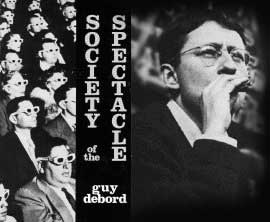
The Society of Spectacle


Understood in its totality, the spectacle is both the result and the goal of the dominant mode of production. It is not a mere decoration added to the real world. It is the very heart of this real society’s unreality. In all of its particular manifestations — news, propaganda, advertising, entertainment — the spectacle represents the dominant model of life. It is the omnipresent affirmation of the choices that have already been made in the sphere of production and in the consumption implied by that production. In both form and content the spectacle serves as a total justification of the conditions and goals of the existing system. The spectacle also represents the constant presence of this justification since it monopolizes the majority of the time spent outside the production process.


Guy Debord, The Society of Spectacle, Thesis n° 6

Friday, November 19, 2004

The Post Spectacular Portable Audio

SoniqCast’sElement Aireo MP3 player with built-in WiFi
Posted May 25, 2004, 11:09 AM ET by Peter Rojas
Related entries: Portable Audio, Wireless


It sounds like we’ll be waiting a long, long time (maybe forever) for Apple to go wireless and add AirPort Extreme the iPod, but CNET has a review of the first and only MP3 player (so far) to come with built-in WiFi, the Element Aireo from SoniqCast. We’re not convinced that just being able to cut the cord is worth its $300 price tag or the fact that it only has a puny 1.5GB of storage (though this might actually be an advantage once you realize how long it’d take to transfer 20GB music over an 802.11b), but SoniqCast is promising a software upgrade for the Aireo that’ll let users wirelessly swap tunes with each other, which is something we’ve wanted to see for a long time.

Tuesday, November 09, 2004

The post-spectacular web

Applying Distributed XML to The Open Source Paradigm Shift
by Steve Mallett

http://www.oreillynet.com/pub/wlg/5530

Tim O'Reilly has written and spoken often on what he coins “The Open Source Paradigm Shift”. I've heard Tim give this speech a few times, and read it a few to boot. The one major point that sticks with me is that the software we “use” is no longer just on your desktop/laptop, but the software of the internet that we use everyday a la Google, eBay, Salesforce.com & Amazon to use his prime examples.

Tim goes on to point out that this software that exists only through our browsers or APIs, doesn't play by the same rules as does software that we download and use on our own machines. If I download the source code to the Apache HTTP server I can then compile it and use it in accordance to its open source license. This does not apply to a Google or an eBay. Even if you could download the code that runs Google you couldn't just stick it you home directory and start it up.... there's no value there. It's not the same thing at all. It's Infoware.

This is the point in Tim's speech that the brakes go on for me. For me open source is two things. One practical, the other touchy-feely. The first thing is that open source creates a practical benefit to me in that is works better. The other is the value of trust it gives me. The code is open, it can be forked at will when someone does something evil. Those two characteristics in combination make my wheels turn for open source software. So, what happens when the software I depend on slowly shifts to Infoware that I can never really touch and that while still immediately practical gives me no assurance that it can't be taken away or misused at will without any recourse available to me?

I think we can apply the same principles to the data as we have to the source code. Google, eBay, Amazon, et al. are really only as useful as we allow them to be through the information we give them. We still hold the cards here which means we have options.

My proposed solution is based on backlash at social network sites and some XML based projects I follow. Social networking sites, like friendster, orkut, etc, are really the ultimate in Infoware. There is no value whatsoever in the sites without the data we supply. In this case it is our network of acquaintances... our friends in XML.

When the first social networking site came out we all saw some value in it. It genuinely would be helpful to be able to reach out through people we know to find the perfect match for some need. Then came the copycats. “Are you my friend?” quickly became a joke and people tired
of giving up their info. At about the same time those who continued to like the idea of social networks devised a project named FOAF (Friend of a Friend). The concept here is that the owner of the data (that's you) creates one XML file containing your acquaintances (the info in 'Infoware') and distribute that as you like.

Another XML file based project I've been following is DOAP. Edd Dumbill wanted to apply the same idea as FOAF to Description of a Project. This is an XML file that contains all the info you'd ever want to know about a software project in one place that doesn't require being duplicated by hand in the handful of open source project sites.

Both of these projects are based on reducing the bother of an activity centered around the Infoware concept. But, there is a further use of following this model. We own and control the data. The info in Infoware is ours to dictate the terms of its use.

Let's apply this to an sample case. A good one is Google. You can and sometimes do tell Google to bug someone else. You do it with a robots.txt file on your webserver. For those unfamiliar Google looks for these in websites and if it says “Google, bugger off!” it does.

I could extend this model to an Amazon, or whomever challenges it (Amazone), with the data I provide it in terms of book reviews. Here I register as an Amazone user, tell it where it can find my bookreview.xml file and go my merry way knowing that if Amazone decides that if it wants to pull a fast one in the future I can change access to that information and give it to their competitor thus 'forking' them.

[This would have been an extemely useful feature this week with one of Friendster's employees being fired for blogging. We could have collectively pulled our network of friends in the blink of an eye, but as is, they 0wn J00!]

What led me to thinking about this are GPX files. These are GPS data files that describe GPS location co-ordinates. They are written in XML to insure interoperability of the data among GPS handhelds and software. There is another website that is basic Infoware: Geocaching.com It specializes in collecting and distributing information that it collects from users. They haven't done anything evil that I'm aware of, but they don't make GPX files freely available. People upload GPS information in a webform, the website turns it into a GPX file, and hides it behind a specialty 'service'. It does make the information available in a normal web page form, but this still seemed a bit weird to me and a first step towards begging to be forked. Plus, I'd like to make GPX forms from scratch. How do I make them distributable? Like DOAP and FOAF.

So let's apply my homemade GPX files to the Open Source Paradigm Shift. I create the valuable data, I tell those who are interested in it where it is under the condition that it is theirs as long as I choose to grant it to them. That's to say, conduct yourself as to make me want to continue to help make your Infoware useful.

In this model I believe that the freedom to innovate and improve data, as opposed to software code, is best served by being largely distributed and in the hands of the many.

There are some legal considerations here along the line of granting copyright of the information to one large organization to fight on one's behalf as the FSF encourages, and some attribution rights that people would want preserved. I think this could be best addressed with a very simple combination of the FSF copyright assignment and a creative common's attribution license. We'll leave that racket for another day.

This essay is available for further editing at mod_foo in the editorial queue. If you have anything to add or detract I'd love to see your editorial comments there as it goes to publication.

Steve Mallett is the founder and managing editor of OSDir.com, and mod_foo. His life can be found here in one light meaty snack.
Comment on this weblog
You must be logged in to the O'Reilly Network to post a comment.
Trackbacks appear below the discussion thread.
Post Comment
Trackbacks
Comments made on other sites via trackbacks appear below.

# Trackback from Marc's Voice
Entrance and Exit strategies - owning your own data
2004-09-12 14:14:05
OK - got to London, took care of family business and now I'm getting ready for tomorrow night by catching up with the blogosphere. One thread I've been watching carefully and with enthusiasm - is Jon Udell and Jeremy Zawodny talking about Flickr, Delicous and next generation web apps. I actually signed up to talk about this very subject for Web 2.0 - so I gotta get real nerdy - and boned up on the minutia. One thing I can say is "I agree!" In fact - "I wanna own my own data" was the title of the talks we...
# Trackback from shanti's daily links
Applying Distributed XML to The Open Source Paradigm Shift
2004-09-10 15:19:22
Applying Distributed XML to The Open Source Paradigm Shift...
# Trackback from The Silent Penguin
Giving our lives away
2004-09-09 07:19:56
Now that next generation web services such as Flicr and deli.cio.us are paving the way, what are the implications of these systems when applied to our personal lives? We're giving our life away. Ok, that's perhaps a bit drastic, but...

The post-spectacular phone

http://www.webcogs.com/the_future_of_phone_calls_is_now.aspx

Last updated 03/05/2004

Opinion Piece by Richard Lowe

I ‘Skyped’ somebody the other day, and you probably don’t know what I’m talking about (unless you already use Skype – in which case, skip along to the second but last paragraph, and my apologies).

Are you interested? Then read on.

Bear with me a moment, and I’ll explain – you’ll catch on later in this article. For years, the only way that you could communicate with somebody over miles of ground and air was the telephone. This worked, and it worked very well. It caused a revolution in communication, as the postal service had done in years gone by with the advent of postboxes, stamps and letters.

Later (much later) came the facsimile/fax – being able to ‘transport’ a written paper document to the other side of the world was impressive, at the time (centuries before the invention of the fax this would have been deemed as ‘witchcraft’).

Then, with the birth of the mobile phone, first as a ‘brick’ and then (as we know it now) a tiny device that fits comfortably into your pocket, communication between people many miles apart became truly portable for the first time in human evolution.

Of course the companies that owned the communications network that interconnected all of these phones and mobiles were the telephone companies. These telephone companies charged for every minute and second of human conversation, quite rightly-so – they needed to not only survive commercially, but make profit in order to be viable businesses. After all, they had a huge infrastructure of cables and telephone exchanges to support.

A number of years later, the Internet was born - another revolution of communication technology that (generally) wholly relied upon this telephone infrastructure to function and eventually become popular with the masses. Telephone companies were very quick to jump on the bandwagon and provide both businesses and consumers with a means to connect to the Net – again (generally), charging by the minute.

However, very quickly, it became not only a global database of knowledge populated by the thoughts, feelings and aspirations of the human race, but also a very effective medium for communication in the form of ‘E-Mail’ – it started to replace the original postal system. Not only between homes and businesses, but between desks in an office. Memos started to become a thing of the past.

Due to the subsequent competitiveness of the Internet Service Provider market (especially after the very dramatic dot com crash), the Internet very quickly became affordable to an awful lot of homes and businesses in the Western world at a fixed monthly cost, rather than on the traditional ‘pay per minute’ business model of the telephone world.

Furthermore, links to the Net from both people’s homes and businesses evolved rapidly from dial-up Modem connections to broadband with the wealth of multimedia and online application choices that this resulted in.

Let me usher you back to the present time.

Along comes VoIP (Voice over IP) – talking to other people over the Internet – using audio – just like a telephone conversation. This technology takes full advantage of the fact that there are many people in the western world that pay for their Internet connection on a fixed monthly fee basis.

VoIP allows you to make telephone calls to other VoIP users without having to ‘pay per minute’ via your telephone company. How? Because your voice is split into packets and routed, over the Internet.

Effectively (and to the despair of many telephone companies, I’m sure) it throws the old and let’s face it, defunct, telephone business model of ‘charging per minute’ on its head. The same telephone companies that were eager to take people’s money on a per minute basis, were just as quick to offer ‘fixed price per month’ Internet access. So we shouldn’t feel sorry for them – they must have seen it coming!

One of the leaders in this technology is a company by the name of ‘Skype’. They are, of course a commercial organisation, but have the foresight to realise that it is not at all trivial to take the droves of telephone/mobile phone-using people and bring them over to VoIP technology. Everybody likes their fixed and mobile numbers.

So they have the perfect solution – give away their Skype software for free. After all, other than a small number of Skype ‘directory’ servers (which store people’s contact details), the actual running costs of offering free voice calls over the Internet is effectively nothing since the calls are routed over the Net – at no cost to them. The clever bit is their software which gives better-than-phone-call quality, generally regardless of the speed of your link to the Net.

This type of technology has been around for a number of years now, but Skype are succeeding where other companies (including big names like Microsoft and Cisco) have failed. You’re probably wondering why. Well, other than the fact that you have a memorable ‘username’ rather than a telephone number, let me explain.

Ultimately, people want to talk. They don’t want to worry about NAT Firewalls, VPNs and all of the other technical issues that are associated with this type of technology. They just want to install the software and talk with either their friends or business associates. They just want things to work, even over a dial-up connection.

This is where Skype appear to be coming from as an offering. Their software is free, works behind NAT firewalls, VPNs and furthermore, they even offer a ‘Skype Phone’ which you can use to call other users rather than use a cumbersome headset/mic combo. It plugs into your USB port and looks like a traditional phone.

A headset/mic combo offers better sound quality (as it should), but we all need to be alerted when somebody is trying to call us, and their phone has a ringer. You can call somebody on the other side of the planet, and not pay a penny.

So what’s the catch, you’re probably asking yourself? There isn’t one. They are committed to users always making Skype calls free, providing that you just want to chat with one person at the other end.

If you want conference calls, video calls and voicemail, then quite rightly so, there will ultimately be a subscription charge in the future. For the record, conference calls are presently free at the time of writing this article (up to five people chatting, regardless of their geographical location).

That’s better than paying per minute, let’s face it. Ok, it’s not free as such, but you don’t pay a penny, as long as you’re hooked into the Net, which for most of us in the Western world is a fixed fee.

To summarise, if you’re the chairman of a very profitable Telephone company, you’ll probably have already clicked away from this article in disgust. But I lay down the gauntlet and ask you why didn’t you see this coming?

However, if, like me, you want to embrace the future of phoning people, or should I say, ‘Skyping People’ then just Google for ‘Skype’ and ask your friends to do so also.

And if you need further convincing, then let me tell you that you that Wi-Fi Skype phones that you can walk around your home or business with are just around the corner.

The future of telecommunications is now – out with the old, in with the new. But hey, that's progress.

Richard Lowe

Managing Director
Webcogs.

The Post Spectacular Healthy Carrier

Howard Rheingold sees a "new economic system" in the unconscious cooperation embodied by Google links and Amazon lists. BusinessWeek Online, Aug. 11, 2004

(sketches from the interview)

Where do you see the social revolution you've been talking about going next?
It's too early to say. The question is: What does it point toward? Some kind of collective action...in which the individuals aren't consciously cooperating. A market is a great example as a mechanism for determining price based on demand. People aren't saying, "I'm contributing to the market," [they say they're] just selling something. But it adds up.

Can you give me some specific examples of what you mean, beyond the market? Google is based on the emergent choices of people who link. Nobody is really thinking, "I'm now contributing to Google's page rank." What they're thinking is, "This link is something my readers would really be interested in." They're making an individual judgment that, in the aggregate, turns out to be a pretty good indicator of what's the best source. Then there's open source [software]. Steve Weber, a political economist at UC Berkeley, sees open source as an economic means of production that turns the free-rider problem to its advantage. All the people who use the resource but don't contribute to it just build up a larger user base. And if a very tiny percentage of them do anything at all -- like report a bug -- then those free riders suddenly become an asset.


post[spect] by ---gallizio

The post-spectacular celly

The everywhere phone

http://www.btplc.com/Innovation/Mobility/everywhere/

A mobile that works over the fixed network - mobility, flexibility, simplicity and...cheaper calls. BT is the first telecoms company to work on this unique application of modern technology to bring customers high quality on-the-move calls at a low cost.

It is simple. One phone that can be used anywhere - home, office or on-the-move in public Bluephone enables sites. It acts like a mobile but it has better reception, better voice quality and is cheaper to use than a mobile because it operates over BTs fixed line network.

A fantasy of the future? No, a reality for next year when the latest BT product - code-named Project Bluephone for now - is scheduled to launch.

It is a step into a different league of telecommunications - one which combines the best of state-of-the art communications technologies and yet offers the domestic or business customer greater simplicity and calls at a cost lower than current mobile calls.

Project Bluephone - the name was inspired by the Bluetooth wi-fi technology it uses - began in April 2003 and a public launch is pencilled in for April 2004. The 12-month development stage could be considered almost leisurely for the man who developed and launched BT Openzone in six months: John Lee.

World first

John, BTs wi-fi general manager Convergence, is heading up Project Bluephone and says, as far as he knows, BT is the only company in the world pursuing this technology combination for its customers.

"Bluephone is a BT-developed product and is the first in the world thats being done this way, although other people are playing with tariffs," he said. "It means you can use a mobile phone when in Bluephone-enabled sites - that could be in homes, offices or public places - and you make your call via your mobile phone over the fixed network rather than mobile network. This gives improved voice quality and improved coverage therefore very good reception over a low-cost, fixed network. Youll still get your mobile voice and data - SMS messages and voice mail - over fixed network.

"The user needs to be within range of a Bluephone-enabled site - home, office or maybe some public sites such as coffee shops - to have the call go across the PSTN network. When out of range, the handset will act as a standard mobile phone and send and receive calls over the GSM network. We are aiming for seamless roaming as the project progresses."

Currently, the project has undergone a successful trial at BT Centre in London and an invitation to tender for the network infrastructure technology - the widest BT has put out - has gone to 65 suppliers. To date it has received a large number of responses from around the world. A full business case will follow, leading to further internal and external trials.

Driving force

Theres a strong commercial driving force for BT to encourage mobile users back on to the fixed network. About 20 per cent of UK households dont have a fixed line - a decline over the last five or six years from a figure that neared 100 per cent at its peak. Research also shows that about 30 per cent of mobile calls are actually made from the users home.

"Even if people have a fixed line they are still making mobile calls from home," said John. "BT wants to maintain and grow its share of the fixed line and mobile revenues."

"The project is seen as being very strategic, putting BT back into the mobile market place, and increasing mobile customers and fixed revenues as well. Its also tied in to existing major business and consumer product development programmes within BT."

These are programmes such as mobility at home, a family-centred package, where a consumer customer can have up to five handsets on one contract. They get free calls up to two minutes long - a handy offering if the households children are calling home to be picked up, for instance.

Bluephone requires a handset containing specially developed software. The intention is that the customer will be able to choose from a variety of BT- or supplier-branded handsets, although some DECT ( Digital Enhanced Cordless Communications) products may be able to be used with the new service.

"We want to make this as cost-effective for the user as possible," said John. "For a reasonable initial outlay, it will be improving the quality of mobile calls, be easy to use and ultimately saving you money. We will be offering significant cost savings against todays mobile spend."

The Bluephone team is expecting sales to rocket as the nation catches on to the benefits.

Said John: "Erring on the conservative side, I predict thousands of Bluephones will be in use next year, and millions in year three. There are 27 million households with a BT line, so if each household buys just one handset, thats a lot of potential sales!"

Sunday, October 31, 2004

The post-spectacular mayor

Manifesto of Industrial Painting: For a unitary applied art
by Pinot Gallizio

Colloidal macromolecules have already made their appearance in the field of art, and although their poet has not yet been found, thousands of artists are busying themselves with the effort to master them.

The great era of resin [trans: also rosin/amber] is inaugurated and with it has commenced the use of matter in motion; the colloidal macromolecule will etch itself profoundly onto the concept of relativity, and the constants of matter will suffer a definitive collapse. Concepts of eternity and immortality will disintegrate, and the woes of eternalization of matter will be reduced ever more to nothing, leaving to the artists of chaos the infinite joy of the "always new."

The novel [trans: literally "il nuovo," or the new: I chose the word novel because there is an oblique response throughout Gallizio's text to Bahktin's formulation of the "novel" vs. the "epic," in which "the novel" refers at once to a literary form and a kind of subversive, carnivalesque element in literature which predates the advent of the long form fiction of the early 18th century designed "the novel" in English. This case here should not be construed as referring at all to the literary prose form, which in Italian, as in French, is named in a way that stresses the continuity of literary forms, not the break, or newness, of the novel. ("romanzo" in Italian, "roman" in French)] -- conceived amidst the risks of infinite imagination and invention: drawn from the liberated energry that man will harness toward the deconstruction of the gold standard, understood as the congealed energy of the infernal banking system already decomposing.

The patented [trans: or licensed] society, conceived of and based on the simplistic notions, the elementary gestures of artists and scientists reduced in captivity from ants to lice, is about to end. Man is expressing a collective consciousness and {wielding} a tool adequate to the transformation to a potlatch system of gifts which cannot be purchased if not with other poetic experiences.

The machine may very well be the appropriate instrument for the creation of an industrial-inflationist art, based on the Anti-Patent; the new industrial culture will be strictly "Made Amongst People" or not at all! The time of the Scribes is over.

Only a continual and implacable creation and destruction will result in an anxious and pointless quest for object-things of transitory use, planting mines beneath the foundations of the Economy, destroying its values or impeding their formation; the ever-novel will destroy the boredom and anguish created by man's slavery to the infernal machine, queen of the all-equivalent; the new possibility will create a new world of the total-diverse.

Quantity and quality will be fused; the arising society of the luxury-standard will annihilate traditions.

Proverbs will no longer have meaning.

For example, the proverb, "He who leaves the old path for the new," etc., will be replaced by, "The proverbs of the old starve the young to death."

A new, ravenous force of domination will push men toward an unimaginable epic poetry.

Not even the habit of establishing time will be preserved.

From now on, time will be merely an emotive value, a newly minted coin of shock, and will be based on the sudden changes arising in moments of creative life, and upon rare instants of boredom.

Men without memories will be created; men in a continual violent ecstasy, forever starting at ground zero; a "critical ignorance" will come into being with extensive roots in the long prehistory of savage man, the magus of the caves.

The new magic will have the more recent spice of the sparks of the conflagration of the library of Alexandria which was the synthesis of the neolithic revolution and which continues in our own times to burn the residue of the urban society of the Sumerians and the nomadism of the Phoenicians, flavoring like a narcotic incense the hopes of man.

So great will be the artistic productions that machines will produce, compliantly bending to our wills, that we will not even be able to fix it in memory; machines will remember for us.

Other machines will intervene to destroy, determining situations of non-value; there will be no more works of the art-champion, but open air ecstatic-artistic exchanges among the people.

The world will be the stage and the by-play of a continuous representation; the new earth will transform itself into an immense Luna Park, creating new emotions and new passions.

The cosmic spectacle offered by humanity will be effectively universal and visible in its total simultaneity at telescopic distance, obliging man to ascend in order to embrace the entire spectacle; the laziest will put their names down in Paradise.

Man is thus launched on the quest of myth.

In the past, the epic was able to create itself on earth; lack of communication, wars, great fears, and the confusion of languages and customs favored in time deformations and distortions of reality; they transformed actions, and synthesized into myth.

Today a myth can only be created with difficulty and when man manages to find himself in special conditions, or launches himself into macrocosm with immense instruments, or descends with miniscule ones into microcosm.

Because of this we must depict the roads of the future with unknowable materials, marking the long path of the Heavens with methods of signing adequate to the grandiosity of our undertakings.

Where today one makes signs with spokes in sodium, tomorrow we will use new rainbows, fatas morganas, aurora borealises that we will construct; the stripteases of the constellations, the rythmic dances of asteroids and ultrasonic music of thousands of fragmented sounds will supply us with moments worthy of demigods.

For all those things and men already powerful: sooner or later you will give us machines to play with or we will fashion them ourselves to occupy that leisure time which you, with demented voracity, look forward to passing in Banality and in making minds progressively into mush. We will use these machines to draw the highways, to make the most fantastical and unique fabrics in which for a single instant the joyous throngs will dress themselves with an artistic sense.

Kilometers of printed paper, engraved, colored, will sing hymns to the strangest and most zealous follies.

Houses of painted leather, of pottery, lacquered, of metal, of alloys, of resin, of vibrantly colored cements will form on the earth an asymmetrical and continuous moment of shock.

We will fix images at our pleasure with cine-photographical and televisual machines, which the collective genius of the people has created, and which you have until now evilly employed in securing for yourselves an absolute reign of Boredom.

Each person will feel the joy of color, of music; architectonic airs of colored gasses, hot walls of infrareds that provide eternal springtime - we will make it so that man plays from the cradle to the grave, and even death will be nothing but a game.

Colored poetic signs will create emotional moments and give us the infinite joy of the magico-creative-collective moment, on the platform of the new myths and passions.

With automation there will no longer be work in the traditional sense, and there will be no more "after work" time, but a free time to liberate antieconomic energies.

We want to found the first establishment of industrial poetry and from this unimaginable and monstrous birth which machines will grant us, we will create establishments of immediate destruction, to obliterate at once the emotional products already created, so that our brains will be forever immune to plagiarism and will be able to find themselves immediately in the state of grace of ground zero.

A people of artists only can survive guided by its brilliant minority: the creators of belief.

The ancient cultures give us examples of this with their inflation; everything was unique and this immense production was impossible without the inclusion of popular elements dragged along in their works of immense poetry.

Once the poetic font dried up, it was a brief step to the ruin of the Maya, of the Cretans, of the Etruscans, etc.

Today man is a part of the machine he has created and which negates him and by which he is dominated.

We must invert this non-sense or there will be no more creation; we must dominate the machine, force it to make the unique gesture -- useless, antieconomic, artistic -- in order to create a new anti-economic society, one that is poetic, magical, artistic.

Powerful and symmetrical lords: asymmetry, at the heart of modern biology, is expanding in the artistic and scientific fields, undermining the foundations of your symmetrical world calculated upon the axioms of poetic moments of a long gone past that has arrived at an absolute immobility in the crystalline Boredom of Your devising.

The ultimate modern artistic creations actuated with a magico-prophetic sense have destroyed space; the long kilometric cloths can be translated and measure chronometrically, like films, like cinerama (twenty minutes of painting, thirty, an hour).

Time, the magic box with which men of ancient agrarian cultures would regulate their vital and poetic experiences, has halted and compelled you to change speed.

The instruments which are the basis of your dominion: space and time, will be useless toys in your childish, crooked, paralytic hands.

Useless your idealist constructs of the Superman and of genius; useless your proprieties, your immense urbanistic formations that bore the insomniac nights of aristocratic spirits capable only of limping about empty palaces, like bats and owls in search of the foul foods of artificial paradises.

Useless and vain your centuries of urbanism, because only to you and for you the people have vainly consecrated their best free creative energies, believing you to be the effective representatives of a poetic message. Today antimatter, the physical antiworld has been discovered and your whole unwieldy dwelling trembles on the precipice.

The anti-man has already appeared in the dramatic scenario of physics. The people will have no use in the future for your purposeless proprieties, which are nothing but vast cemeteries in which you have entombed over the centuries all the pains and the poetry that man has created for you.

New proprieties are required; true nomadism requires scenes for camping, for gypsy caravans, for the weekends.

The return to nature with modern instrumentation will allow man, after thousands of centuries, to return to the places where Paleolithic hunters overcame great fear; modern man will seek to abandon his own, accumulated in the idiocy of progress, on contact with humble things, which nature in her wisdom has conserved as a check on the immense arrogance of the human mind. [Trans: on the Italian philosophical problem of the return to primitive conscioussness, see Vico's concept of "ricorso" in "La Scienza Nuova" (The New Science).]

Lords already powerful in the East and the West, you have built subterranean cities to protect yourself from the radiation which you have savagely: very well, the ingenious artists will transform your sewers into sanctuaries and into atomic cathedrals tracing with emotional magic the signs of the industrial culture that will swiftly transform into the symbols of the new zodiac, the new calendars of fleeting moments.

New energies gathered from the sensitive minority that the masses will express in extended lethargy will transform your termitai [trans: termites? terminals?] of armored cement into opulent, transmittable and exchangeable moments.

Artists will be the teddy-boys of the old culture: that which you have not already destroyed will be destroyed by them in order that nothing is remembered, since your dullness has come to such a point that it has destroyed the last possibility of rebirth left to you: war.

This was always your last resort, since destruction requires renovation: today your cowardice, your fear has exploded in your hands.

You are indefatigable fabricators of Boredom.

Your progress will sterilize the last of your sensibilities, and nothing, if not your civilization, will help you to gasp the last particles of an infected oxygen, prolonging your agony in the emissions of the machines which you yourselves have overworked and exhausted.

The new decorums, stretching from cloth to dwellings, from means of transport to glasses and plates and lighting fixtures to the experimental cities, will be unique, artistic and unrepeatable.

We will not longer use the term "immobili" [trans: literally: unmoveable; it refers to houses, apartments, real estate] but "mobili" [moveables/furnishings], seeing that they will be ephemeral instruments of joy and play; in a word, we will return to poverty, extreme poverty but possessed of wealth of spirit in a new way of acting and being.

Possessions will be collective and have a swiftness of self-destruction.

Poetry will no longer be about the senses which we already know, but those which we have yet to know; it will have no more architecture, nor painting, nor words, nor images, but will be without external surfaces and without volume. We are nearing the fourth dimension, nearing pure poetry, magic without a master, but it can only be if it is total, we are near the savage state with a modern sense, with modern instruments: the promised land, paradise, Eden, can be nothing other than to breathe the air, to eat, to touch, to penetrate. To purify one's self in the air in order to create with these new, impalpable proprieties the new passionate and free man, who no longer has time to satiate all his desires and create new ones.

All ideologies, all religions, follow the politics of desire, never satisfying them if not in the hereafter: the result is that today science and art find themselves facing an impenetrable wall of whys.

We want to wipe out the whys for good.

The new prophets have already breached this infinite and sweet wall of new poetry at its foundations.

The man of tomorrow will, guided by these pioneers, tap into the indestructible nectar which flows from it.

The entire new human way of being and acting will be a game, and man will live all his life for play, preoccupying himself with nothing but the indulgence of emotions arising from the play of his desires.

The first rudimentary tools of this revolution are, in our opinion, artistic-industrial and devaluating, simply because these are above all instruments of joy: and so this is why in proposing our minor results, like industrial painting, we feel arrogantly certain that our hopes are good, judging from the spreading enthusiasm with which they have been received.

Industrial painting is the first attempted success in playing with machines, and the result has been the devaluing of the work of art.

When thousands of painters who today labor at the non-sense of detail will have the possibilities which machines offer, there will be no more giant stamps, called paintings to satisfy the investment of value, but thousands of kilometers of fabric offered in the streets, in markets, for barter, allowing millions of people to enjoy them and exciting the experience of arrangement.

It will be the triumph of great numbers moved by quality, which will establish unknown values, and the speed of exchange will determine a new identity: Value will become identical to Exchange.

It will be the end of all speculation.

The great game began at Turin in 1958, continued in Milan and Venice, was reconfirmed in Monaco in 59 where the Congress of Situationists established that the ten point of Amsterdam were the fruit of a silent but effective premise for a unitary-urbanism.

The subsequent Exhibition of Paris, where environmental construction was successfully demonstrated, the emotion of an instant, demonstrated how cultural unity is the only idea capable of dominating the machine.

We are poor and it doesn't matter, our poverty is our strength.

Its useless for us to stew in our own juices, they will be able to exclude us from their Exhibitions, they will be able to silence us, insult us, humiliate us.

The people have already understood our poetry and already the tribulation of the new poetic moment beats anxiously in the heart of the throngs bored with the exhausted idols fabricated by the hypocritical and self-interested fornication of phantom powers of the earth and their impoverished and miserable artists, snarlingly superintended by all the wheels of the human automatic mechanism of thought and of technology and of the most impotent race on the globe: the intellectuals.

Thus begin the long days of atomic creation.

Now it is the turn of we artists, scientists, poets to create the earth anew, the oceans, the animals, the sun and the other stars, the air, the water, and the things.

And it will be our turn to breath life into clay to create the new man fit to rest on the seventh day.

[Note: dated August 1959, this text by Guiseppe Pinot-Gallizio was originally published in Notizie Arti Figurative No. 9 (1959). Shortly thereafter, it was translated into French and published in Internationale Situationniste no.3 (1959). In May 1997, Molly Klein translated the Italian version into English.]

Tuesday, October 26, 2004

The post-spectacular city

From Doors of Perception: www.doorsofperception.com

September 2003 This is my lecture to a conference at Westergasfabriek, in Amsterdam, called Creativity and the City, on 25 September 2003.

In Rajhastan, travelling storytellers go from village to village, unannounced, and simply start a performance when they arrive. Although each story has a familiar plot - the story telling tradition dates back thousands of years - each event is unique. Prompted by the storytellers, who hold up pictorial symbols on sticks, the villagers interact with the story. They joke, interject, and sometimes argue with the storyteller. They are part of the performance.

Hearing about these storytellers reminded how much we have lost, in the 'developed' world, of the un-mediated, impromptu interactions that once made cities vital.

We now design messages, not interactions. The world is awash in print, and ads, and billboards, and packaging, and spam. Semiotic pollution. Brand intrusion at every turn.

Our buildings are now about one-way-communication, too. Sports stadia, museums, theatres, science and convention centres. Such buildings do an accomplished technical job: they deliver pre-cooked experiences to passive crowds.

And whom do we have to thank for this semiotic pollution, for the catatonic spaces that despoil our physical and perceptual landscapes?

The "creative class". That's who's responsible. In the same way that mill owners optimised mass production, the creative class has optimised the society of the spectacle.

At least mill owners bequeathed us well-made industrial cities. The creative class will be less fondly remembered. Their legacy is meaningless, narcissistic cities.

Luckily, the era of the creative class is over. Point-to-mass advertising, onanistic art, and big-ticket spectacles, are over.

We are in a transition to a post-spectacular, post-massified culture. Our cities, from now on, will be judged by their capacity to foster collaboration, encounter, intimacy, and work. Much like cities used to be judged, before they fell into the hands of the creative class.

I'll explain more about these design criteria for cities in the second half of my talk. In the first half, I explain just why it would be foolish to dedicate our cities to 'creatives' and the impoverished, sender-receiver model that informs their activities.

SPECTACLES MAKE US BLIND

There are three reasons why it would be foolish to entrust the future of our cities to the creative class.

The first is its autism. Autism is defined in Webster as "absorption in self-centred subjective mental activity, especially when accompanied by a marked withdrawal from reality".

An example. A week ago I attended a meeting here in Amsterdam on the subject of "Hosting" The invitation posed an interesting question: ”What is the relationship between art biennales, and their host cities?" Many international art powerbrokers turned up for this meeting, which was hosted by an organisation called Manifesta. Ten or 12 of them sat round a table.

In the event, the meeting was a waste of time and space. All the curators and critics and producers discussed were 'viewers' and 'audiences' and 'publics'. They banged on endlessly about the business of biennales, but lacked any insight into the changing nature of business.

It dawned on me, as I struggled to stay awake, that Art has become most attractive to the interests it once ridiculed.

The tourism industry loves art because its events and museums are 'attractions'. Property developers love art because a bijou gallery lends allure to egregious projects. For city marketers, an art biennale bestows glamour, and an aura of intelligence, on a city.

"Our events are not summer camps", pleaded Franco Bonami, director of the Venice Biennale. (Mr Bonami invited more than 500 artists to this year's event). But he did not mention one single word about what, if anything, these 500 people had to say - or why the rest of us should care.

After two hours I had to leave. "Hosting" felt like a sales meeting for Saga Holidays.

So then I went to Japan where Prada, which is said to be 1.5 billion euros in debt, has lavished $87 million on a new Herzog and de Meuron-designed store, in Tokyo. Now for Aaron Betsky, (a previous speaker, Director of the Netherlands Architecture Institute) the Prada building would be a right and proper thing to do. Shopping, he just told us, is the fundamental purpose of cities today.

For me, the whole Prada project smells like the last days of Rome. The Plexiglas exterior, which is like bubble-wrap, certainly stands out. The new shop is on the Tokyo equivalent of P C Hooftstraat. (Amsterdam's fashion street). I popped in for a look.

Ten minutes. Quite nice. Been there, done that.

Prada spent 87 million bucks on a clothes shop that contained nothing I wanted to buy, but that's their right. A creative consultant called Christopher Everard told The Economist that, "by using iconic architects, the label is building brand equity". Mr Everard's firm is called "InterLife Consultancy". I emailed him the suggestion that he change its name to "Get A Life Consultancy" - but he has not replied.

Besides, Pravda’s investment is chickenfeed, a mere grain of corn, compared to Tokyo's Roppongi Hills tower. This 800,000 square metre monster had just opened when I was there. No expense has been spared by Yoshiko Mori, its developer, to compensate local people for the sacrifice of their old neighbourhood to progress and creativity. Several traditional features have been retained, I was told, including a Japanese garden, a Buddhist temple, and a children's park.

When I visited Roppongi Hills, these human-scale traces of old Tokyo proved hard to find. They were hidden among the 200 shops, 75 restaurants, and a zillion square feet of office space and apartments that fill the building.

The Zen garden may be lost, but compensation and enlightenment await you at the top of the tower: the Mori Museum of Art.

A Who's Who of the global art establishment - including Nicholas Serota from the Tate, and David Elliot, its British Director - have joined this lavishly funded enterprise. Glenn Lowry from the New York MoMA is also on board, apparently unperturbed by his client's appropriation of the Moma name.

The museum opens next month with a biting and critical look at the modern society which begat it. The show is called, ”Happiness: a survival guide for art and life".

Only people with a 'community passport' are admitted to this Xanadu of art-as-happiness. The passport, curiously, closely resembles a credit card. But still: it gains you access to all those shops and restaurants and - piece de resistance - an orange bar designed by Conran Associates.

The art museum itself was not yet open when I visited, but six museum shops were. They were doing a roaring trade.

"Art, design and happiness" says the brochure, "the kind of place that we want to become".

Not of all of us, Mori-san. "Tourism - human circulation considered as consumption - is fundamentally nothing more than the leisure of going to see what has become banal". Guy Debord wrote that more than 40 years ago, in The Society Of the Spectacle. He would not have warmed to Roppongi Hills.

In much the same way that that tourism kills the toured, 'cultural industries' like museums-and-shopping destroy diversity and desolate their host environment. CIs are like GM crops: bland, tasteless, and a threat to the ecosystem.

I do not deny that the economic case for the creative class is strong. After all, designing all those spectacles is big business.

A new trade fair and exhibition in Philadelphia, which calls itself "Exp", announces itself as "The Event That Defines The Experience Industry". I didn't go to Exp, but I did go to the website. The middle-aged, white male speakers boasted a remarkable collection of jowls and bad haircuts. They promised to tell me, "how to gain a greater share of your guest's discretionary time and disposable income"; how to "destroy the myth that great experience need huge budgets" (sic); and, "how to surf the generational shift".

The website did not mention a session on how to speak English, but this omission did not deter the creative classes. They flocked to Exp - enthralled. no doubt, by its convenient clustering of four key themes: Corporate Visitor Centres, Retail, Casinos, and Museums.

The other big spectacle business is sport. Sophisticated Paris, in its bid for the Olympics, says that sport is replacing culture as an attractor in urban regeneration. "The role that investment plays in the Games of the 21st century will be comparable to that played by industrialisation at the end of the 19th century", burbles their bid.

Claude Bebear, chairman of the Paris Olympic Committee, does not think of sport as kicking a ball around a field. He thinks about twenty million dollar sponsorships, and the well-being of the people who provide the spectacle. Claude's plan for a sporty Paris features private road lanes for the exclusive use of athletes and officials. A travel time of 12 minutes, from bed to track, is promised to the muscle-bound sportspersons and their crypto-fascist paymasters. If the bed-t-track journey proves too taxing, an internet and electronic games centre will be provided to "help athletes relax and get in touch with the outside world". Le Moniteur, eds, 2001, Paris olympiques: twelve architectute and urban planning projects for the 2008 games, Paris, Editions du Moniteur

ACTION MAN

But I digress. I've made the point that pre-programmed cultural 'attractions' and 'experiences' are on the wane. The nightmare of "art and design as happiness" is nearly over.

And I should also stress that the "creatives" who make them are not personally to blame. They - we - are the symptom, not the cause, of a cultural affliction that touches us all.

So what are alternatives? This brings me to the second part of my talk.

Tor Norretranders, in his book The user illusion, explains beautifully what's missing from the mediated, specacular, dis-located, and disembodied experiences that blight our lives. Once we know what's missing, we can put it back.

"Most of what we experience we can never tell each other about" writes Tor. "During any given second, we consciously process only sixteen of the eleven million bits of information that our senses pass on to our brains".

In other words, the unconscious part of us receives much less information than the conscious part of us. We experience millions of bits a second but can tell each other about only a few dozen.

Humans, concludes Norretranders, are designed for a much richer existence than processing a dribble of data from computer screen, or a wide-screen display in Times Square.There is far too little information in the Information Age. Spectacles may be spectacular, but they are low bandwidth.

"I believe that a desirable future depends on our deliberately choosing a life of action, over a life of consumption. Rather than maintaining a lifestyle which only allows to produce and consume, the future depends upon our choice of institutions which support a life of action".

That was Ivan Illich, in 1973. Thirty years ahead of the rest of us, Illich argued for the creation of convivial and productive situations - including our cities. A sustainable city, Illich understood, has to be a working city, a city of encounter and interaction - not a city for the passive participation in entertainment. www.infed.org/thinkers/et-illic.htm

What matters most in a post-spectacular city is activity, not architecture. As the director Peter Brook has said, "It is not a question of good building, and bad. A beautiful place may never bring about an explosion of life, while a haphazard hall may be a tremendous meeting place. This is the mystery of the theatre, but in the understanding of this mystery lies the one science. It is not a matter of saying analytically, what are the requirements, how best they could be organized ‹ this will usually bring into existence a tame, conventional, often cold hall. The science of theatre building must come from studying what it is that brings about the more vivid relationships between people."

Tame, conventional, cold. How many buildings do those words recall? Torsten Hagerstrand has studied dysfunctional spaces - and good ones - and how people use space and time for thirty years. He says it is the ability to make contact with people that determines the success of a transport system or location. Hagerstand [q in Whitelegg) Hagerstrand T, Space time and the human condition, in Karlquist A, Lundquist L, and Snickars F (eds) Dynamic allocation of urban space, Saxon House, Lexington MA 1975

Peter Brook, too, as I said, asked us to focus on what it is that what it is that brings about "the more vivid relationships between people."

One of those things is the mobile phone. It's impacting remarkably on our interactions with space and community. Mobile phones stimulate connections between people who already know each other, or have something in common. They can also help crowds assemble, as we saw in Seattle, in 1999.

That's not major news. The more interesting change is the way wireless communications connect people, resources, and places to each other on a real-time basis, and in new combinations. Demand responsive services, as they call them in the (service design) trade.

Traditional city planning designates different zones for different activities: industrial, residential and commercial. Telecommunications are changing the nature and inter-action of activities that "take place" in these three types of location.

Think of the taxi systems you have encountered. They are demand responsive services, to a degree. The old model was that you would ring a dispatcher; the dispatcher offers your trip all the drivers on a radio circuit;

One driver would accept the job; and the dispatcher would send that taxi to you.

A better way, now being introduced in many cities, is that you ring the system; the system recognises who you are, and where you are; it identifies where the nearest available taxi is; and it sends that taxi to you. Dynamic, real-time, resource allocation.

Now: replace the world "taxi" with the word sandwich. Or with the words, "someone to show me round the back streets of the old town". Or the words, "a nerd to come and fix my laptop" Or the words, "someone to play ping pong with". Or suppose you feel like helping out in a school, and hanging out with kids for a day.

In every case, networked communications, and dynamic resource allocation, have the potential to connect you, with what you want. It just needs to be organised.

You could be a supplier, too. Perhaps you have time on your hands. Make good sandwiches. Know the old town like the back of your hand. Have a nerdy daughter who's looking for work. Know there's a ping-pong table in Mrs Graham's garage, which they never use. Or perhaps you don't feel like dealing with Form 5 on your own this week.

What do you do? You call the system. Or the system calls you.

The reason I've jumped from the creative class, to mobile phones and networks, is this. If the post-spectacular city is about person-to-person encounter, technology can help us achieve that. The consequence can be a profound change in the ways that we operate, and live, in cities.

With networked communications we will be able to access and use everything from a car, to a portable drill, only when we need it. We won't have to own them, just know how and where to find them.

Did you know that the average power drill is used for ten minutes in its entire life? Or that most cars stand idle 90 per cent of the time? The same principle - of use, not own - can apply to the buildings, roads, squares and spaces that fill our cities.

But the killer app is access to other people. People is what makes cities different from other places. The creative city will be the city that finds ways to strip out all the transaction and infrastructure costs that make it expensive to hire people to help us do stuff.

In retrospect, we got the information age completely wrong. We thought it would be smart to remove people from services: we called it 'disintermediation'. It reads as it was: a pain in the nexk.

We also thought we couild do without place.Nicholas Negroponte stated in Being Digital, the dotcommer's bible, that "the post-information age will remove the limitations of geography. Digital living will depend less and less on being in a specific place,at a specific time". Lars Lerup,dean of the architecture school at Rice University - and a dotcommer manque - proclaimed in a book approriately named Pandemonium that "bandwidth has replaced the boulevard. Five blocks west has given way to the mouseclick. After thousands of years of bricks held together by mortar, the new metropolis is toggled together by attention spans." Brandon Hookway, 1999, PANDEMONIUM Princeton Architectural Press New York.

All that stuff was, in retrospect, piffle. But we all did it, including this speaker. He apologises, and pleads only that he is a tiny bit wiser after the event.

The point is that the information age has been added to the industrial age. Telematic space has been added to Cartesian space. The one did not supplant the other.

And mobile phones and networks do not make the city disappear. On the contrary, they render the city itself more powerful as an interface.

Sometimes this is at the level of tools. Experiments are under way in which mobile phone act like a remote control to activate technology in our surroundings. You stand at a bus stop, and summon up your personal web page on one of the panels. J C Decaux, or Viacom Outdoors, control millions of such urban surfaces which could be used for such an application.

Researchers at Interaction-Ivrea, in Italy, had another good idea: connect these displays to the printers in ATM machines. You could print out SMS messages, or a local map, on the ATM printer.

Other projects treat the whole city, not just its furniture, as an interface. A project called New York Wireless, for example, has identified more than 12,000 wireless access hot points throughout Manhattan alone, and put their location on a website."The result is a new layer of infrastructure", says co-founder Anthony Townsend."But no streets were torn up. No laws were passed. This network has been made possible by the proliferation of ever more affordable wireless routers and networking devices. Mobile devices re-assert geography on the internet".

Marko Ahtisaari, a future gazer at Nokia, says that enabling proximity - getting people together, in real space - has become a stratgic focus, the killer application of wirelsss communications."Mobile telephony might seem very much to do with being apart, but a lot of telecommunications behaviour is aimed at getting together physically in the same place", he says.

Proximity and locality are natural features of the economy. Worldwide, the vast majority of small and medium-sized companies - that's most of all companies - operate within a radius of 50km. Most of the world’s GDP is highly localised. Local conditions, local trading patterns, local networks, local skills, and local culture, are critical success factors for the majority of organizations.

Mobile phone and wireless-enabled gadgets enable us to access people, or resources, or services - just-in-time, and just-in-place.

By doping that, they also design away the need for mobility, or much of it. Demand-responsive services, combined with location-awareness, combined with dynamic resource allocation, have the capacity dramatically to reduce the mobility-supporting hardware of a city: its roads, vehicles, malls and car parks.

Imagine there's a kind of slider on your phone. You set it to "sandwich" and "within five minutes walk" or "within a five dollar cab ride" - and use those parameters to search for whatever it is you need.

You don’t need to own it. You don't even need to go far to get it. You just need to know how to access it.

MONDAY MORNING TO-DOS

Talks like this one are supposed end with a list of things you might do on Monday morning. But I just criticised creatives for over-designing our cities, so it would be hypocritical of me to give you a list of things to do.

So let me summarise. I have said that we are in a transition to a post-spectacular, post-massified culture. It's for this reason that it would be foolish to hand over our cities to the "creative class".

They just don't get it. More to the point, their business model drives them on. Our cities are over-designed because the creative classes get paid for designing things.

'Creatives' don't get paid for leaving well alone.That's a conundrum we'll need to resolve.

The second part of my talk touched on some of the ways wireless communication, and networks, enable people, places, and things, to be connected in new and often unexpected ways - and times. I also explained that the information age has not replaced the real-word age - but it is certainly transforming the ways we use and live in it.

I do have one suggestion for what you can do on Monday morning. Go out and buy Italo Calvino's wonderful book, Invisible Cities - of which the following is an extract:

“The Great Kahn contemplates an empire covered with cities that weigh upon the earth and upon mankind, crammed with wealth and traffic, overladen with ornaments and offices, complicated with mechanisms and hierachies, swollen, tense, ponderous. "The empire is being crushed by its own weight” Kublai thinks, and in his dreams,cities as light as kites appear, pierced like laces, cities transparent as mosquito netting, cities like leaves’ veins, cities lined like a hand’s palm, filigree cities to be seen through their opaque and fictitious thickness”